



What happens after childhood repair?
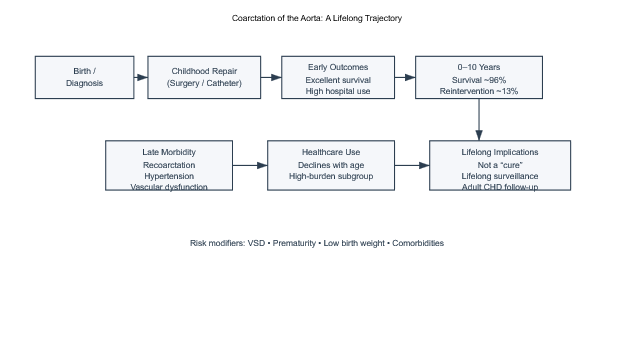
Dorobantu and colleagues present an important national analysis of outcomes after childhood repair of coarctation of the aorta, using linked registry data from England and Wales. Their study challenges the idea that the condition is simply “fixed” after early intervention. Survival is excellent, but the effects of coarctation can continue long after the initial repair.¹
The study included 3,321 patients, followed for a median of 12.2 years. Mortality was low, with a cumulative incidence of 3.7% at 10 years after birth, reflecting the success of modern surgical and catheter-based treatment. Yet 13.3% of patients required another intervention within 10 years. Early repair, particularly in infancy, does not always mean the end of treatment.¹
A lifelong condition, not a one-off defect
These findings support a broader change in how we think about coarctation of the aorta. Rather than a single anatomical problem that is corrected once, it is better viewed as a lifelong vascular condition. Even after a successful repair, patients remain at risk of re-coarctation, high blood pressure, and vascular dysfunction.
Hospital use falls as children get older
One reassuring finding is the sharp decline in hospital use over time. Median hospital stay was highest in the first year of life at 26 days, falling to just 1 day per year beyond the age of 8. For most children and families, this suggests a move towards relative clinical stability.
A smaller group, however, had much higher healthcare use. This was particularly true for children with a ventricular septal defect, prematurity, low birth weight, or other medical conditions. These factors can help identify children who may need closer follow-up and more support.
Different treatments bring different trade-offs
The comparison between treatment strategies is also important. Catheter-based repair was linked with a higher chance of later reintervention than isolated surgical repair, although the initial hospital stay was shorter.
This reflects a familiar trade-off. A less invasive procedure may offer a quicker recovery but may also carry a greater chance of needing another procedure later. This does not mean one approach is inherently better than the other. Treatment needs to be tailored to the individual child.
Hospital admissions do not show the whole picture
Hospital admission data may also underestimate the true burden of the condition. Long-term problems such as high blood pressure, reduced exercise capacity, and neurodevelopmental issues are often managed in outpatient clinics and may not appear in hospital admission data. Falling hospital use is reassuring, but it does not mean that all longer-term health problems have disappeared.
Why lifelong follow-up still matters
The practical message is clear. Children with coarctation of the aorta need structured, lifelong follow-up, with particular attention to blood pressure and recurrent narrowing of the aorta.
Transition to adult congenital heart disease services is an important part of maintaining that care.
Families should also receive balanced advice. Most children will do very well, but ongoing monitoring and the possibility of further treatment should be expected.
Overall, this study shows that outcomes after childhood coarctation repair are excellent, but the condition does not simply disappear after treatment. Lifelong follow-up, tailored care, and clear communication with families remain important for achieving the best long-term outcomes.
Reference


Authors Heartbeat Sub-Editor: Aleena Haider Aleena is an academic cardiology trainee at Imperial College London with a strong commitment to all aspects of cardiovascular medicine,

Author Heartbeat Sub-Editor: Dr Khin Kay Kay Kyaw I am currently working as cardiology specialist registrar ST6 at southwest peninsula region while also working as

Author Sub-editor: Dr Pok-Tin Tang Dr Pok-Tin Tang is an ST5 cardiology registrar in the Thames Valley deanery, currently undertaking a period of out of

Author Sub-editor: Dr May Hu Dr May Hu is a cardiology trainee in the North West deanery. She graduated with First Class Honours from the University

Author Sub-editor: Dr Jhiamluka Solano Dr Jhiamluka Solano is a cardiology resident doctor (ST6) in the Yorkshire and Humber Deanery, currently undertaking a DPhil (PhD)